Black Radical Reflections · № 015 · 19 May 2026
Why One Hundred Years of Solitude Isn’t a Masterpiece
Beautifully-Wrapped But...
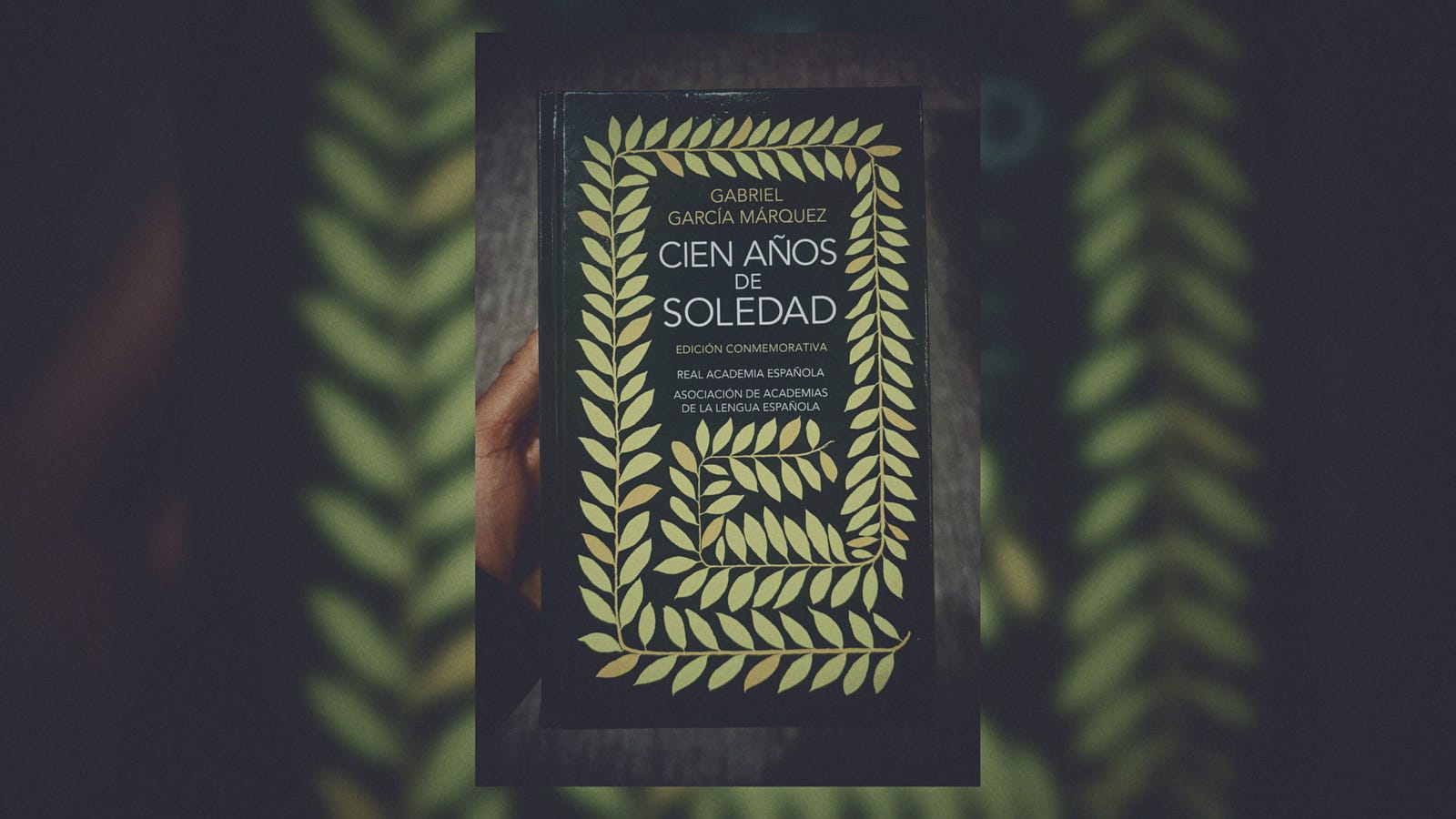
Some books get handed to you like a moral vitamin: essential, elevating, culturally mandatory. One Hundred Years of Solitude is one of them. For years I heard the praise. William Kennedy claimed it was the first piece of literature since Genesis worthy of required reading for all humanity. That phrase traveled. It was repeated, affirmed, canonized in every list of books worth reading. I kept hearing so much praise that I finally decided to read it myself. And I was disappointed.
Not disappointed in the writing. The prose is lush. The world Márquez builds is intricate. But disappointed in what the book does to a reader without warning them about it. Disappointed that the constant recommendation to read this book came without any moral context for what it normalizes. For those of us who can’t ignore the harm and refuse to make excuses for it, this book becomes hard to read. It’s like torturing yourself. The people who praise it have trained themselves to stop seeing what’s there. I couldn’t do that, and I won’t.
Its defenders speak in reverence (”masterpiece,” “genius,” “biblical,” “foundational”), and the conversation closes before it opens. This isn’t polite dissent from the canon. Márquez frames incest, coercion, and child abuse through tone, narrative speed, and mythic inevitability in a way that operates less like critique and more like aesthetic laundering. The novel doesn’t fail because it depicts harm. It fails in how it depicts harm.
A novel can portray a violation and force the reader to confront it. The interior damage. The power dynamics that made it possible. The consequences that ripple out. Márquez chooses a different path. He narrates harm with casualness, stylizes violation as romance or fate, and refuses to insist on ethical clarity. Readers defend the book by saying it shows the degeneration of a family and a town. Depicting degeneration doesn’t answer the harder question: where’s the narrative insistence on the reality of violation? When the voice glides past what should be shattering, the book trains you to glide with it. That’s a choice, and it produces a particular kind of readerly complicity.
§ I
The Founding
The first problem is the foundation of the story. Macondo is often remembered as a pre-modern paradise where reality is porous and the world still feels new. Many readers treat it as an Eden later destroyed by history, war, capitalism, and corporate exploitation. But Macondo’s origin is not innocent, and origin stories function like moral blueprints.
The Buendías do not build their world out of ethical maturity. They flee. José Arcadio Buendía marries his first cousin Úrsula in spite of the family’s terror that they will produce a child with a pig’s tail. Úrsula fears him so much on their wedding night that she wears reinforced sailcloth drawers locked with an iron buckle. He responds by spearing a neighbor through the throat in a cockfighting dispute over Úrsula’s virginity, then walks into the bedroom where his wife is putting on her chastity pants and orders her to take them off at spearpoint. The novel calls what follows that night “frolicking in bed until dawn, indifferent to the breeze that passed through the bedroom, loaded with the weeping of Prudencio Aguilar’s kin.” Márquez tells you the dead man’s family is weeping in the next house over while the killer and his wife consummate. Then he calls it frolicking.
That sentence is the moral structure of the book in miniature. Coerced sex on the night of a killing rendered as a domestic pastoral, with grief audible in the wind but never weighted. The patriarch then leads a crossing of the mountains so the ghost of the man he killed will stop washing his throat wound in the kitchen. Macondo begins as relocation. Move guilt to a new geography and rename it destiny.
This is why Macondo reads as cult-like when you stop romanticizing it. The town organizes itself around the Buendías’ obsessions and reproduces their dysfunction as tradition. Communities built on unprocessed guilt reproduce guilt. They call the reproduction fate. That is what happens here. The founding violence (a murder, a coerced consummation, a marriage already taboo) becomes the template the book then circles for a century.
§ II
Incest as Atmosphere
Incest is not a peripheral theme in One Hundred Years of Solitude. It is the air the family breathes: feared, discussed, flirted with, warned against, fulfilled. Readers treat it as a symbolic device for circular time or the isolation of Macondo from outside kinship. Symbolism is not a moral alibi. A book can use incest as a symbol and still narrate it in ways that feel casual or cosmically inevitable, and that is what happens here.
Consider Aureliano José and his aunt Amaranta. He has slept in her bed since childhood, to overcome his fear of the dark. She bathes with him through his early adolescence. One night, Márquez writes, “he felt Amaranta’s fingers searching across his stomach like warm and anxious little caterpillars.” The verb is “searching.” The image is “caterpillars.” A grown woman penetrates her young nephew with her fingers, and the prose offers caterpillars. The narration calls what develops “inviolable complicity,” a phrase that splits the burden between an adult and a child as if they were equal partners in a secret. Amaranta finally pulls back, not because she recognizes harm, but because she “realized that she had gone too far, that she was no longer playing kissing games with a child.” The book’s own voice phrases incestuous abuse as a “kissing game” that went on a little too long.
Or the closing of the family circle: Aureliano and his aunt Amaranta Úrsula. Their first sexual encounter is, in the literal text, a rape. He picks her up “like a pot of begonias” and throws her on the bed. She says “go away.” He pulls off her robe “with a brutal tug” before she can resist. She “defended herself sincerely,” tries to knee him in the kidneys, tries to claw his face. Márquez calls it “a fierce fight, a battle to the death.” Then, mid-paragraph, the assault metamorphoses into seduction: “the affray degenerated into a conventional gambol and the attacks became caresses.” She “dropped her defense,” and the prose marches her into a discovery of “what the orange whistles and the invisible globes on the other side of death were like.”
A rape becomes a transcendent communion in three sentences. The mythic voice does the work no realistic narration could. If the same scene appeared in a contemporary novel without the magical-realist lacquer (a man overpowers his aunt, ignores “go away,” strips her by force, fights her into submission, and the narrator calls the moment she stops resisting an awakening), readers would name it correctly. Márquez gives them lush vocabulary instead, and they hand him a Nobel.
When taboo is narrated as destiny, the ethical frame shifts. The reader is encouraged to read the act as narrative completion: an endpoint the story has been moving toward. If the culminating incest closes the circle, the horror of boundary collapse converts into the satisfaction of pattern. That is how literature normalizes without endorsing. The unacceptable becomes aesthetically coherent.
§ III
Child Abuse Dressed as Romance
The novel’s treatment of children is the place where the moral problem stops being arguable. This is not child sexuality. This is child abuse. More specifically, it’s childhood sexual assault. What the prose does is render predatory attraction the way a predator would romanticize it: as fate, as love, as something the child will eventually consent to.
Aureliano Buendía sees Remedios Moscote, the magistrate’s youngest daughter, and falls in love with her. She is nine. Márquez writes that her age “could have been his daughter” and that the thought of her bothered him “like a pebble in his shoe.” When he later asks Pilar Ternera to intervene on his behalf, Pilar laughs and says, “You’ll have to raise her first.” That line is a joke in the book. A grown man wants to marry a child, and the older woman jokes that he’ll have to raise the child first. Then the family helps arrange it. Remedios’s parents wake her up in the middle of the night to confirm the engagement. She is still playing with dolls when she moves into Aureliano’s room. She dies before age fifteen, hemorrhaging from a pair of twins crossed in her stomach. Her room “decorated with the dolls and toys of her recent childhood” is how the prose describes her marital bedroom.
The novel mourns her with tenderness. The narration does not name what was done to her. It names her “merry vitality.” The summary mode does the moral work: by sliding from her engagement to her death in a few pages, the book treats a child’s pregnancy and obstetric death as an episode in the family’s emotional weather, not as the predictable end of an adult man marrying a nine-year-old.
The pattern repeats. José Arcadio, on a night when he is in turmoil, walks to a gypsy fair and sees “a very young gypsy girl, almost a child.” He approaches her from behind and “pressed against her back. The girl tried to separate herself, but José Arcadio pressed more strongly against her back.” She is described, when she undresses for him, as “a languid little frog, with incipient breasts and legs so thin that they did not even match the size of José Arcadio’s arms.” A grown man rapes a child whose breasts have not yet developed. This is not romance. This is not the way of the world. This is predation, and the prose turns it into poetry. Márquez gives us “incipient” and “languid,” words that travel in the perfume aisle of literary fiction, words that romanticize what should horrify. The narration moves on within a paragraph. There is no rupture in the page.
The Pilar Ternera backstory is told in a single subordinate clause: she “had been part of the exodus that ended with the founding of Macondo, dragged along by her family in order to separate her from the man who had raped her at fourteen and had continued to love her until she was twenty-two.” Raped at fourteen, continued to love her. The two phrases share a single sentence and the second one is positioned, grammatically, as if it softens the first. A child rape recedes into a love story by the time the comma arrives.
This is the technique. Compression and tone. The narrative skims across decades, summarizing lives, and that speed makes the rape of a child read as a minor narrative detail. Instead of forcing the reader to inhabit the harm, the book folds it into the flow of “things that happen” in Macondo. The result is training, not discomfort. When the text treats exploitation as custom or initiation, it invites the reader to adopt the same stance. Prose does not have to say “this is good” to create the feeling “this is normal.” Normalization travels through tone and speed, not explicit argument.
§ IV
Women as Functions
Rape and coercion run through the novel not as labeled events but as structures of sexual entitlement. The Buendía men move through women with a logic of possession. The narrative treats this as part of the texture of masculine life rather than as a moral failure that should rupture the story’s fabric.
Women in Macondo are positioned as functions. Pilar Ternera is the family’s all-purpose womb (she produces children for two Buendía brothers, then dies at over a hundred forty-five years old running a brothel they all visit). Úrsula is endurance. Amaranta is bitter virginity. Remedios the Beauty is sexlessness so pure her body rises into heaven on the laundry sheets. Petra Cotes is fertility magic. Fernanda is repression. None of them is permitted the interior life of a moral subject whose violation reshapes the world around her. They reshape around their violations, then reshape again, then die.
A novel can portray misogyny and violence to critique them. Critique requires pressure. The narration has to insist on interior consequence, reveal the psychic cost, disrupt the mythic calmness. When harm is narrated as routine, it becomes part of the landscape. And routine harm is exactly what a culture normalizes.
§ V
Craft as Moral Anesthetic
This is where craft and ethics become inseparable. The same stylistic qualities admirers praise (the sweeping omniscience, the mythic cadence, the biblical tone, the compression of time) flatten moral reality. A narrator who reports miracles and violations in the same calm voice produces an atmosphere where everything feels equally fated. The pianola that plays itself, the rain that lasts four years, the girl who ascends to heaven, the nine-year-old bride, the nephew who rapes his aunt: all delivered in one register. The register is wonder. Wonder applied uniformly across a moral spectrum cancels the spectrum.
This is not “told not shown” as a technical preference. It is “told not shown” as an ethical mechanism. Márquez never makes the reader sit inside the damage. He keeps the narration moving, summarizing, drifting forward. Damage becomes narrative material rather than moral rupture. The writing can sound poetic while skipping the hard work of moral confrontation. Add that’s exactly what’s being done here.
The famous opening sentence (Colonel Aureliano Buendía facing the firing squad, remembering the afternoon his father took him to discover ice) telegraphs the whole technique. A man about to die remembers a childhood marvel. Wonder collapses violence. That is the move Márquez performs again and again, at every scale, for four hundred pages.
§ VI
The Writer’s Responsibility
A writer carries responsibility for what the work conditions readers to accept. This is not about censorship or avoiding difficult subjects. A novel can depict rape, incest, child abuse, and the grinding structures that produce them. The question is not whether to write about darkness. The question is whether the writing prompts a reader to analyze the darkness or to become complicit in it.
The distinction is real and it matters. A writer can portray a violation and position the reader as a witness forced to confront what was done, or the writer can portray a violation and position the reader as a participant in the violation’s normalization. The method is not the subject. The method is the voice, the pace, the vocabulary, the refusal to linger on consequence. The method is what trains a reader.
Consider what happens when a narrative treats coercion as seduction, when it renders assault in mythic language, when it moves past a child’s exploitation in a single paragraph. The reader is not being asked to analyze. The reader is being trained. Each time the prose glides past what should arrest the eye, the reader’s threshold shifts. The reader becomes accustomed to the glide. The reader learns to glide along. That is conditioning. A writer can train a person to be complicit in rape and abuse by the simple choice to not insist that the reader see it. The glamour helps. The lush prose helps. The distance of magical realism helps. But the core mechanism is the refusal to stop. The refusal to make the reader sit with the weight of what occurred.
Márquez chose not to insist. He had the skill to do it. The novel proves that when he writes the banana massacre with unflinching clarity. But at every moment where he could have disrupted the mythic calm and forced the reader’s attention onto harm within the family, he chose the flow instead. He chose to move on. He chose to trust the music of the prose to carry the reader past the moment when clarity would have mattered. That is a choice a writer makes, and it produces a particular consequence: readers finish the book convinced they have read something profound, when what they have actually done is train themselves to accept a story where the vulnerable are harmed and the harm is rendered beautiful.
The book is disturbing. Not because it depicts a dark family in a doomed town. Disturbing because the prose teaches you not to be disturbed by a child marriage, a rape, an incestuous cycle, the systematic exploitation of women. The book does not ask you to think about these things. It asks you to feel the poetry and move on. That is the disturbance: not what is shown, but how thoroughly you are trained to stop seeing it.
§ VII
The Banana Company Alibi
This is also why the common nostalgic framing fails. Readers blame the outside world (the war, the modernization, the banana company, the rain) for Macondo’s destruction. The novel does dramatize those forces with visible outrage. The banana massacre sequence cuts. Three thousand workers and their families gunned down at a train station, the bodies hauled away on a train of two hundred cars and dumped in the sea, and then the official denial that anything happened at all (”the banana company had never existed”). That set piece is the novel at its moral best, because Márquez stops there. He inhabits the horror. He makes the lone surviving witness, José Arcadio Segundo, carry the unbelieved truth for the rest of his life.
But this only proves the point. Márquez can write with moral clarity when he chooses to. He chooses not to when the violation is inside the family. The banana massacre gets outrage. The rape of an aunt by her nephew gets “orange whistles and invisible globes.” The state’s machine gun is named. The patriarch’s spear at his wife’s chastity drawers is “frolicking.”
That imbalance encourages readers to mourn Macondo as a wholesome community ruined by outsiders. Macondo is structurally sick from the founding. The banana company does not invent Macondo’s moral disorder; it recognizes a community already trained in domination and denial, then scales that disorder into industry and policy. The town can be exploited so completely because the town has already normalized exploitation inside its own family structure. The banana company is the accelerant. It is not the seed.
§ VIII
What Reading Culture Does With This
The book does not exist in a vacuum. The way it gets taught and praised is part of the problem. Students and reviewers are expected to glaze over the incest, the underage marriages, the coerced sex, the predation, and clap for the symbolism. That is not sophistication. That is conditioning.
The constant recommendation matters. Saying that it should be required reading for humanity, is a bit much. It’s even been called the “Bible” of Latin America. It’s why so many people picked up the book in the first place. The recommendation carried authority. The authority was unexamined. Anyone recommending this book to others should be required to name what it normalizes. The recommendation without the warning is itself a form of harm.
“Magical realism” becomes the fog machine. The label lets the reader call moral collapse “myth,” lets exploitation pass as “folklore,” and lets the reader feel cultured while skipping the basic ethical question: why is the narration so casual about things that should be treated as violations? The canon trains readers to celebrate the aesthetics and outsource the moral reaction, and then it treats that outsourcing as a sign of intelligence. The well-read student learns to praise the prose and avert the eyes. The well-read critic learns to write about “circular time” and “the burden of memory” so they do not have to write about a nine-year-old in a marriage bed.
The defense often takes a specific shape. It says: García Márquez is depicting a patriarchal culture, not endorsing it. Critique requires evidence in the text. Where is the line, the scene, the structural choice in the prose that breaks the spell and forces the reader to name what is happening? Show me Márquez naming what was done to Remedios. Show me the page where the assault on Amaranta Úrsula is allowed to remain an assault. The prose smooths every one of those moments. A novel that “depicts without endorsing” needs the depiction to land. Márquez’s depictions evaporate on contact.
§ IX
The Semantics Trap
A second defense moves the conversation into semantics. The argument turns on word choice. Was Remedios technically a bride or technically a child bride? Is Aureliano’s pursuit of a nine-year-old technically pedophilia, or technically hebephilia, or technically the customs of a different time and place? Was Amaranta Úrsula technically raped or technically seduced, since the prose says she ended up “consenting”? Was Pilar Ternera technically raped at fourteen or technically in a relationship with a man eight years her senior across that period?
This rhetorical move launders the violation. The label becomes the battlefield, and the child disappears behind the debate. The argument turns into “Well, technically,” and what gets lost in that little technical detour is the larger moral reality: an adult pursued a child. An adult overpowered an unwilling woman who said “go away.” A man with a spear ordered his wife to undress on the night he killed a man. The “technically” exists to give readers permission to keep enjoying the prose. Word choice becomes the issue so that behavior can keep being a footnote.
I’m not interested in having a conversation that treats terminology as the main question while treating exploitation as a footnote. If the first impulse on encountering Remedios is to argue about the difference between marriage and child marriage in nineteenth-century Caribbean Colombia, the impulse is minimization dressed as clarification. The protected thing in that move is the reader’s pleasure in the novel. Not the child.
The same laundering happens through softening vocabulary. Critical essays describe Remedios as “very young” rather than nine. The Amaranta Úrsula assault is called “the consummation of their passion.” The gypsy child is “his lover.” These are not neutral choices. They shift attention from the violated party to the comfort of the audience that wants to keep loving the book. Neutrality is not the goal when the subject is exploitation of children. Clarity is.
§ X
The Netflix Adaptation
The 2024 Netflix adaptation doesn’t solve the problem. It deepens it. Film and television are aesthetic amplifiers. They turn tone into mood, mood into seduction, and seduction into consensus. The series is beautiful. The beauty is the delivery system. Visual elegance does not transform exploitation into wisdom, and it does not absolve a narrative that still packages violation as fate. When you take a story written in a mythic, smoothing voice and translate it into lush cinematography, prestige pacing, and reverent presentation, the harm in the source material does not neutralize. It gets a higher resolution.
A specific example: the early Aureliano-Remedios courtship in the show is staged with soft light and longing looks. The visual grammar of the scene is romance: shy young woman, patient older man, gentle approach. The child’s age is mentioned in passing. The visual frame stays in the romance register, and a viewer who has not read the book leaves the scene believing they watched a love story. The book gave the prose the cover of mythic distance. The series gives it the cover of period romance. Both covers do the same work. They make a viewer feel cultured while a child is married off on screen.
A prestige series enters a machine of recommendation, awards, and social proof. It becomes a new layer of cultural reinforcement: the story gets reintroduced to a wider audience as something to admire, something to celebrate, something to absorb as important. The selective reading gets rewarded again: admire the beauty, praise the scope, mourn the fall, condemn the outsiders, keep your moral vocabulary quiet when the narrative treats exploitation as folklore. A prettier frame does not impress me. Dressing a harmful myth in expensive aesthetics makes it easier to consume and harder to question.
§ XI
My Final Thoughts
One Hundred Years of Solitude is not a masterpiece to me. Not in ethics. Not in emotional honesty. Not in craft, in the way craft is often praised. Its mythic voice reads as detachment dressed as wisdom. Its lyrical reputation rests on a narrative style that smooths harm into atmosphere. Its nostalgia is a trap that encourages mourning for a town that was never morally sound.
Macondo is not destroyed only by the outside world. Macondo collapses because it is founded on unprocessed violence, sustained by repetition, and saturated in a sexual ethic of boundary failure the narrative treats as destiny. You can call that complex if you want. I am calling it a beautiful wrapper around something rotten, and a cultural test for how easily readers can be trained to praise what they refuse to name.
I wouldn’t recommend this book, but please don’t let that stop you from reading it. Independent thought matters, and I fully support it. At least now you know what you’re getting into. I wish someone had warned me before I believed the hype. If you do read it, I’d love to hear what you think. Let’s keep the conversation going.
Author’s Note
My name is Saipher Zureti. I am a visual artist and writer. All of the calligraphy in my essays is my original artwork, created specifically for the writing it accompanies.
This Substack is a body of philosophical essays on manipulation, identity, psychology, and the systems that shape how we see ourselves and each other. The essays build on each other deliberately. Each one extends, complicates, or deepens what came before, because these subjects cannot be understood in isolation from one another.
If something here clarified what you were already sensing, please subscribe. Thank you for being here.
Until next time, Namaste.