Black Radical Reflections · № 006 · 19 April 2026
The Architects
Edward Bernays, Willie Lynch, and the Psychological Infrastructure of American Control
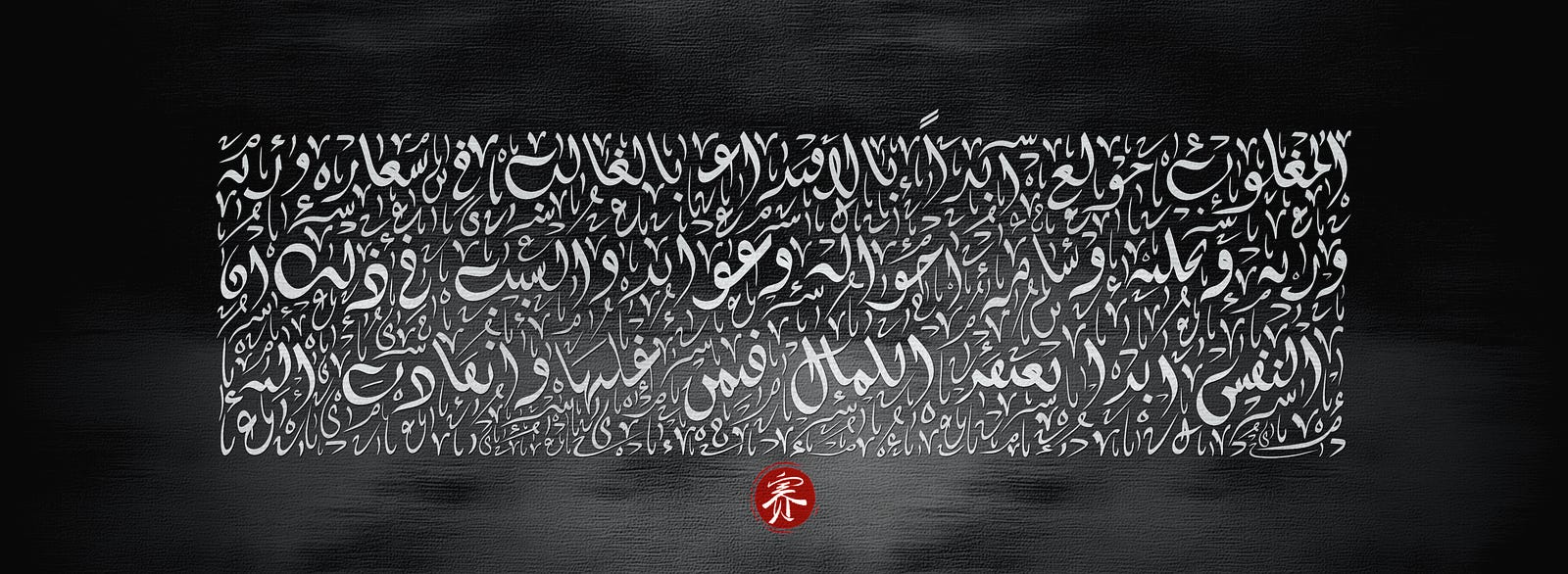
المغلوب مولع أبداً بالاقتداء بالغالب في شعاره وزيه ونحلته وسائر أحواله وعوائده. والسبب في ذلك أن النفس أبداً تعتقد الكمال فيمن غلبها وانقادت إليه
The vanquished always want to imitate the victor in his clothing, his vehicles, and all his conditions and customs. The reason is that the soul always sees perfection in those who overcame it and to whom it submitted.
The Arabic calligraphy above is of a quote taken from Chapter 23 of Ibn Khaldun's Muqaddimah, written in 1377. The passage reads: "The vanquished always want to imitate the victor in his clothing, his vehicles, and all his conditions and customs. The reason is that the soul always sees perfection in those who overcame it and to whom it submitted." I chose this quote because Ibn Khaldun named the internalized oppressor five centuries before Frantz Fanon gave it a clinical framework, and six centuries before the Willie Lynch letter put it into circulation as a description of American slavery. He is describing the same psychological mechanism this piece examines: the conquered person does not simply lose the battle. They lose the ability to see themselves outside the victor's terms. The soul, as Ibn Khaldun puts it, begins to associate defeat with deficiency and dominance with perfection. That confusion is not a personal failing. It is what conquest is designed to produce. It is the foundation upon which both Bernays and the Lynch framework operate. Neither system would function without it. The Muqaddimah is one of the most important books ever written, and one of the least read by people who would benefit most from it. Ibn Khaldun was a 14th century Arab historian and social theorist who essentially invented the disciplines of sociology and historiography before Europe had names for them. The book is an introduction to his larger history of the world, but it stands entirely on its own as an analysis of how civilizations rise, decay, and collapse from within. I recommend it without reservation.
After publishing Oligarchy, I found myself reading the Willie Lynch letter, again. It’s a quick read, which I do recommend. Afterwards, I was sitting with my iPad, working on a new calligraphy piece, when my mind drifted back to Edward Bernays. Then something became clear that I had not seen stated directly before: the psychological infrastructure of American society was not built by accident or by the slow drift of culture. It was architected. Two frameworks, one from the annals of public relations and one from the annals of slavery, together constitute the most comprehensive system of psychological control in American history. Bernays engineered the consent of the masses. The Lynch framework engineered the division of the dispossessed. One managed the population from above. The other ensured that the most brutally exploited segment of that population would remain too fractured to resist from below. This is the third in a series of interconnected essays.
The management of a population requires more than law, force, or economic coercion. Those tools are visible and therefore vulnerable to resistance. The most durable systems of control operate beneath the threshold of conscious awareness. They shape perception, manufacture identity, and turn the governed against one another so that the governors need not lift a hand. Americanism established how consent is engineered through the techniques that Edward Bernays systematized and made respectable. Oligarchy identified the class that benefits from that engineering and named the political arrangement it produces. What remains is the question that neither of those pieces fully answered: how does the population most victimized by the arrangement remain prevented from dismantling it? The answer requires understanding both architects simultaneously, because neither framework is complete without the other.
The document known as the Willie Lynch letter purports to be a speech delivered in 1712 by a slaveholder advising others on how to control enslaved Africans by exploiting internal differences of age, skin tone, and proximity to the master. Some historians have claimed it is a fabrication, arguing that it contains anachronisms incompatible with early eighteenth century usage and that it surfaced not in colonial archives but in the 1970s, gaining wide circulation through the internet decades later. Whether the speech occurred or not is a question this piece will not pretend to settle. What is not in question is the framework itself. The physical and psychological mechanisms the letter describes, the public torture of enslaved people before their families and community to break individual will and demonstrate the futility of resistance, the deliberate separation of men from their children to destroy paternal bonds, the systematic humiliation designed to strip a human being of dignity until submission felt indistinguishable from survival. Weather or not these were not invented by the letter’s author doesn’t change the fact that they are confirmed in the historical records of American slavery in plantation diaries, legal documents, the testimony of the enslaved themselves, and the accounts of abolitionists who witnessed what the institution produced. The letter did not describe a hypothetical system. It described an operational one. That is precisely why the question of its authorship is irrelevant to the analysis. The tactics existed before the letter, during it, and long after it. The letter simply gave them a name. It provides language for understanding internal division and psychological destruction as manufactured conditions rather than natural failings, and that language has proven accurate regardless of who wrote it or when.
The intellectual tradition that most rigorously examines that condition belongs to Frantz Fanon. Writing in the 1950s and early 1960s, the Martinican psychiatrist and revolutionary theorist produced two works that remain essential to any serious analysis of psychological control under conditions of racial subjugation. In Black Skin, White Masks, Fanon examined what happens to the consciousness of a colonized or subjugated person over time. The colonized subject, exposed perpetually to a system that treats the dominant group’s values, aesthetics, and language as the standard of civilization, begins to internalize those standards. They measure themselves by the oppressor’s scale. They seek validation from the oppressor. They experience their own culture, their own features, their own community, as inferior, not because those things are inferior but because the entire symbolic environment in which they live has been engineered to produce that conclusion. In The Wretched of the Earth, Fanon extended this analysis to the political consequences of internalized oppression. A colonized population that has absorbed the values of its colonizers does not unite against the system that oppresses it. It turns on itself. The violence that cannot be directed outward, at the actual source of subjugation, is redirected inward, against members of one’s own community. Division becomes the default condition. Unity becomes psychologically difficult, almost unnatural, not because the people are naturally divided but because the system has manufactured division as a survival mechanism for itself.
The Willie Lynch framework is a compressed articulation of precisely the dynamic Fanon analyzed at length. The method it describes produces what Fanon called the internalized oppressor: the individual member of a subjugated group who adopts the values and perspective of the dominant group, polices their community by those values, and measures the worth of their peers by standards designed to exclude them all. The most visible contemporary manifestation is the phenomenon of the exceptional individual, the Black person who achieves a measure of success within the dominant society and is then deployed as evidence that the system is not broken. If she could do it, why cannot you? The implication is that those who have not achieved similar success have only themselves to blame. The system is exonerated. The individual is indicted. The successful person, meanwhile, is frequently required to perform what can only be called ritual betrayals to maintain their position. They must distance themselves from the community. They must demonstrate that they are not one of those Black people. They become, in the most precise sense, the public relations department for the system that oppresses them. This is the Lynch framework and the Fanonian internalized oppressor operating in the present tense.
Edward Bernays provided the complementary architecture. A nephew of Sigmund Freud, Bernays understood before almost anyone else that human beings are not primarily rational actors. They are driven by unconscious desires, by fears and longings that operate below the level of deliberation. His insight was that those drives could be managed systematically. He refined this understanding as a propagandist for the United States Committee on Public Information during the First World War, where he learned that the most effective propaganda does not announce itself. It presents itself as news, as the obvious conclusion of any reasonable person. After the war, he rebranded the practice as public relations, a linguistic shift that was itself an act of engineering consent. He was not a manipulator. He was a counsel on communication. The population was not being managed. It was being informed.
The techniques Bernays developed were applied at every level of American political and commercial life. He attached cigarettes to female liberation and broke a social taboo by making the act of smoking a performance of identity rather than a preference for tobacco. He arranged a pancake breakfast at the White House to soften a president’s image, demonstrating that political perception could be manufactured as efficiently as commercial demand. He worked for the United Fruit Company to manufacture public support for the CIA’s overthrow of Guatemala’s democratically elected government in 1954, supplying journalists with curated information that transformed a nationalist land reform program into a communist threat. In each case the method was identical: manage the environment of symbols and associations such that the public arrives at the desired conclusion believing it to be the product of its own free will.
These are not separate legacies. They are interlocking components of a single apparatus. The Bernaysian system engineers the national identity, Americanism, that demands loyalty and preempts dissent. It narrows the political imagination to a binary that serves oligarchic interests regardless of which option is selected. It ensures that the population at large remains distracted by manufactured cultural conflict while the substantive levers of power remain undisturbed. The Lynch framework and the Fanonian internalized oppressor ensure that the population with the most direct experience of the system’s violence, and therefore the most urgent reason to dismantle it, remains occupied with internal divisions that the system itself produced. Colorism, the tension between Black men and Black women, the hierarchies of class and education and speech within Black communities, these are not organic pathologies. They are the residue of a deliberate strategy. The two systems do not merely coexist. They protect each other. As long as the Lynch dynamic is operational, the Bernaysian apparatus faces no serious challenge from the people most harmed by what it protects. And as long as the Bernaysian apparatus controls the terms of public discourse, the Lynch dynamic is never named or examined in a context that might allow it to be dismantled.
Fanon understood that the path out of this condition was not individual achievement or assimilation. It was the recovery of consciousness: the refusal of the colonizer’s values, the reclamation of one’s own perception, the recognition that the division is manufactured and therefore not inevitable. Malcolm X enacted this refusal in political terms when he named the Democrats, the Republicans, and Americanism as three mechanisms of the same system and exited the frame entirely. The psychologically free individual does not seek validation from the apparatus. They see the apparatus for what it is.
This series has traced the architecture of that apparatus across three pieces. Americanism established the techniques. Oligarchy named the structure of power those techniques serve. This piece names the two foundational architects and the intellectual tradition that makes their work legible. The book will go further. It will trace these frameworks through specific historical periods, through the politics of respectability and the weaponization of Black success, through the Fanonian analysis of internalized oppression as it operates in the present, through the mechanisms by which manufactured division is maintained and the conditions under which it has been overcome. That work belongs in a longer form. What this preview has attempted to do is place the architecture on the table so it can be seen whole.
The first step toward freedom is recognizing the cage. These two frameworks describe the bars.
Author’s Note
My name is Saipher Zureti. I am a visual artist and writer. All of the calligraphy in my essays is my original artwork, created specifically for the writing it accompanies.
This Substack is a body of philosophical essays on manipulation, identity, psychology, and the systems that shape how we see ourselves and each other. The essays build on each other deliberately. Each one extends, complicates, or deepens what came before, because these subjects cannot be understood in isolation from one another.
If you want to continue reading and thinking through these systems with me, please subscribe. Thank you for being here.
Until next time, Namaste.